There was a time when finding a dentist in Canada was simple. Word of mouth, a referral from a neighbour, maybe a sign near your local plaza. The decision was personal, geography-driven, and largely offline. Those days are gone and they are not coming back.
Today, 8 out of 10 Canadians begin their search for healthcare providers, dentists included, on Google. The search bar has become the new front door to every dental practice across the country, from downtown Toronto to Victoria to Halifax. And that front door is being redesigned from the inside out by Artificial Intelligence.
The question for every dental practice owner in Canada is not whether this is happening. The question is – are you visible in the world that is being built?
The Search Shift Nobody Saw Coming
Online search used to be a bridge. A patient types “dentist near me in Mississauga”, Google surfaces relevant results, the patient clicks through, reads, decides. Straightforward logic. The search engine’s purpose was to get you out of the search engine quickly, and into the right hands.
Generative AI has flipped that logic completely.
Search engines today want the user to stay. AI-generated answers now sit at the top of results, summarising information pulled from hundreds of websites, including yours, without the patient ever visiting your page. Think about that for a moment. Your years of content, your patient testimonials, your carefully written service descriptions – all of it could be feeding a machine that answers patient queries without sending a single visitor to your website.
This is not a distant forecast. This is the search experience Canadians are already navigating.
The Canadian Dental Market Has Entered a New Phase
Canada presents a unique and urgent landscape for this conversation. The country has among the highest per-capita internet penetration rates in the world. Canadians are early adopters, they research everything before making a decision, healthcare included (isn’t it!!).
Now add the expansion of the Canadian Dental Care Plan (CDCP) to this picture. Millions of previously uninsured Canadians are actively searching for dental services they can now access. New patients are searching right now, at this very moment, for practices that can serve them.
The question is – who are they finding?
Practices with the right digital foundation are capturing this demand. Practices without one are simply absent from the conversation, regardless of how exceptional their dentistry is. Good clinical work is not enough. You have to be found before you can be chosen.
How AI Decides Who Gets Found
Here is where it gets genuinely interesting. Generative AI search does not rank websites the way conventional SEO once did. It is no longer just about keywords. AI tools evaluate entities, your practice as a whole – its reputation, content depth, local signals, and web presence consistency.
Think of it in layers,
Trust Signals: Google evaluates whether your practice is a legitimate, established entity. This comes from consistent business listings, an optimised Google Business Profile, and verified patient reviews across platforms. Thin or inconsistent data signals are not good in the AI era.
Content Authority: AI-powered search evaluates whether your website genuinely answers the questions patients are asking. Not keyword-stuffed pages. Real, patient-centric answers. Can a first-time visitor understand your services, your process, and why they should call you?
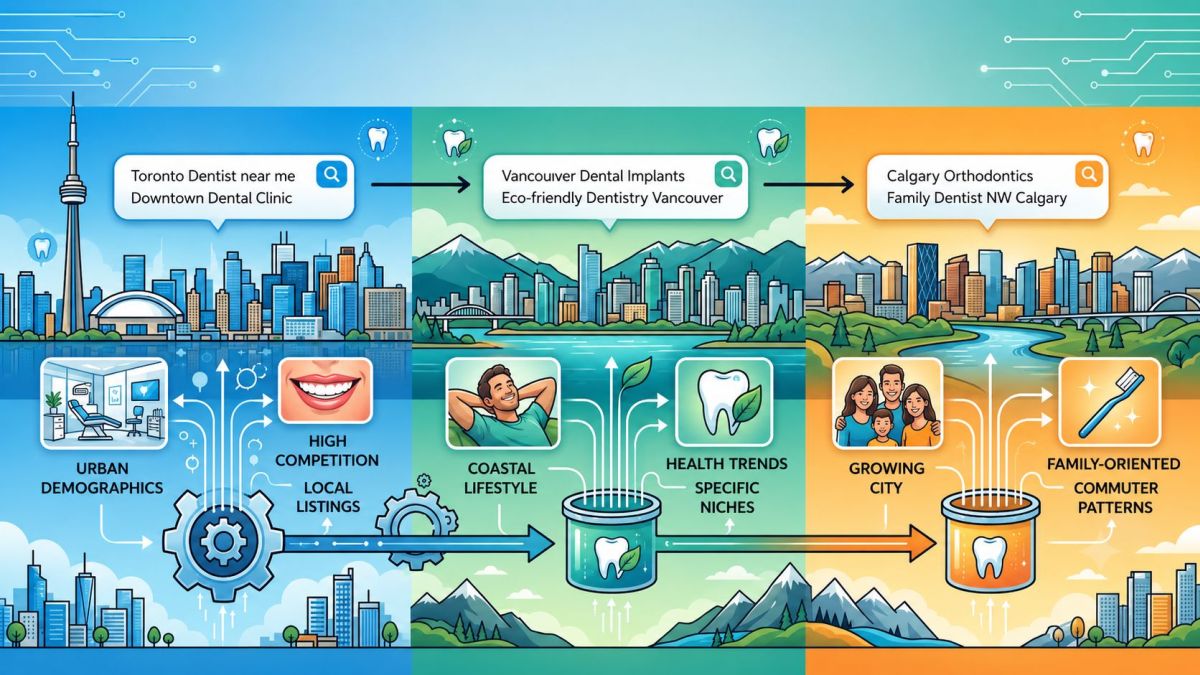
Local Relevance: For dental practices, local SEO is everything. AI search has sharpened its ability to understand geographic intent. A patient in Burnaby is not looking for a dentist in Ottawa. Hyper-local optimisation separates the visible from the invisible.
E-E-A-T: Experience, Expertise, Authoritativeness, Trustworthiness. Google’s guiding framework rewards practices that demonstrate real-world credibility.
Two Types of Dental Practices in Canada Right Now
Let me be direct about something. There are essentially two types of dental practices operating in Canada today.
1) Practices that understand that the digital patient journey has fundamentally changed. They are building content ecosystems, managing their online reputation systematically, optimising for AI-era search, and treating their digital presence as a long-term asset. They are growing steadily, often without spending heavily on ads.
2) practices are still running a website built in 2017. Maybe they tried Online Ads once. They believe word of mouth is enough, that patients will find them somehow. They are slowly becoming invisible, not because their dentistry is poor, but because the landscape moved on without them.
The uncomfortable reality? Type 2 practices are delivering their best potential patients directly to competitors, every single day, for free.
What Forward-Thinking Practices Are Doing Differently
The smartest dental practices in Canada are not chasing AI tools, they are building foundations that AI naturally rewards.
Tech-savvy clinics create content that genuinely educates patients at every stage of the decision process, optimise for local search across Canadian cities and communities.
They build real reputations through consistent review generation and community engagement, treat their Google Business Profile as a living asset, not a one-time setup.
I personally believe that one dental practice with a strong, strategic SEO foundation will outperform ten competitors spending on random digital advertising. Because visibility compounds over time. Paid traffic stops the moment spend stops. SEO builds equity that grows month after month.
The Window Is Open, But Not Forever
Technological shifts create windows of opportunity that do not stay open indefinitely. The practices that establish strong digital authority in this early AI-search era will build a competitive position that becomes exponentially harder to displace later.
AI will not make great dental SEO irrelevant. It will make mediocre SEO worthless and strategic SEO more powerful than it has ever been.
The search bar is how Canadians find their dentist today. How that search experience works is evolving faster than most practices are prepared for.